One of the most beautiful things about sports is how it brings people together. Fans of different sports all over the world can come together to watch their favorite athletes and sports teams compete at the highest level. For most fans, what they see is the final product, the results. Athletes are known for what they can do physically based off of how well they perform in their respective field of play. Have you even stopped an wondered, at what cost does it take for these athletes to continually generate these physical performances? The worst part of all sports that does not receive the glam and glory is injuries.
It does not matter which sport you participate in, injuries are bound to happen. Now the extent at which athletes are at risk of injury does in fact differentiate depending on the sport. Playing Football in my case is almost like a roller coaster ride. A career with a stretch of thrill, but somewhere along the ride you are bound face brutal pitfalls of injuries. Have you ever heard the saying that, “Football is a gladiator sport”? At the highest levels, hundred-thousands of fans will pack into a arena to watch the physically violent clash of their beloved sports teams. Like the gladiator times of ancient Rome, fans will strongly align with a side and cheer at the sight of pain being induced on the opponent. An associate professor of Classics and Ancient Mediterranean Studies and History at Penn State states that, “Large-scale sporting events create intense bonds among fans, provoking feelings of belonging, validation and camaraderie. Individuals feel part of a greater whole, and they feel empowered.” (Hicks) Also much like these times in ancient Rome the emphasis was not on the wounded, but rather the warrior who came out victorious as they were celebrated over bloodshed. The sad reality is, no one cares too much about the fallen or even the damage the was taken taken by the victor.
Injuries are simply a part of the game. The NCAA conducted a study specifically on injuries that occurred from the 2004-2009 football seasons. It was found that, “The overall injury rate in NCAA football is 8.1 injuries per 1,000 athlete exposures” (NCAA) That means for every 1,000 collective practices or games of all the teams associated in the NCAA, there is about 8 injuries that occur. The statistic mind-boggling when you think about the roughly 65,000 student-athletes that participate in those football exposures through the NCAA. Throughout these five seasons, there were also 23 non-fatal catastrophic injuries reported. However, there were 11 fatal injuries that were from indirect catastrophic injuries. This is described by the National Center for Catastrophic Sports Injury Research as, “fatalities that are caused by systemic failure as a result of exertion while participating in a football activity or by a complication that was secondary to a nonfatal injury.” (NCCSIR)
One of the most recent examples of a fatality from an indirect catastrophic injury was the tragedy of Jordan McNair in 2018. On May 29th of 2018, Jordan McNair a 19 year old collapsed while participating in football workouts at the University of Maryland. During the work out he was reported to have shown signs of extreme exhaustion, as well as a loss of equilibrium. He was rushed to a local hospital where he passed away due to a heatstroke that was sustained during the workout, with reported body temperatures of 106 degrees (ESPN) This tragedy ties back into my fundamental question, at what is the cost? In the world of college football, the off-season is equally as important as the regular season. This is a time where you are faced with the physically treacherous strength and conditioning team workouts, and participating in those is to only considered to be doing the bare minimum. It is a time where you train as hard as you can so that when the season comes around you have the slight advantage over your opponent. All of this physically demanding work just so you and your team can ultimately be the ones who stand in victory and glory. This young man’s body was literally pushed to the limits and in the most unfortunate and tragic scenario, the expense was his life.
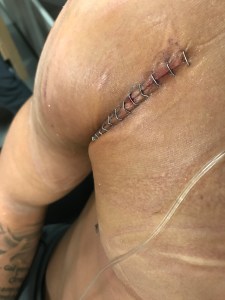
Throughout my time here at Oregon State as a student-athlete I have faced a plethora of them. By the end of my junior year some of my serious injuries included; 3 torn shoulder labrums, 2 torn ankle ligaments, 1 severe concussion, and 1 fractured vertebrae in my neck. That list is substantial enough to end a career. In these times the highlights of sports in your life turn to gloom, and you feel as if you are walking down a dark path. A path that is not filled with camaraderie from fellow teammates and fans, but rather loneliness and uncertainty. In March of 2019, I did not know if I would ever be able to play football again. During a spring practice I had a scary collision with a steel fence that borders our practice fields here at Oregon State. Immediately upon impact, the pain was like nothing else I have felt before. The practice was stopped as the medical staff rushed to my attention. The whole thing was a blur to me, but I remember laying on my back unable to move until the paramedics arrived. As they carefully cut my pads off of me and dissembled my helmet piece by piece, with tears streaming down my face I told my coach, “I just want to play.” As I rode away in the ambulance, I couldn’t help but think if I was leaving a piece of my life behind for good. Fortunately for me, the doctor diagnosed me with only a fractured vertebrae in my neck. He said if it were not for me lifting my head up in a split second decision before colliding with the fence, I would have been paralyzed. I was beyond blessed to have made a full recovery and return to doing what I love.
I love a game that will never love me back. I play football because I am passionate about competing and playing my heart out to accomplish goals with my teammates. When you face serious injuries that is all taken away from you momentarily, and in the most unfortunate cases it is taken away from you forever. Football does not love anyone back. The physical toll that it takes on your body is unavoidable. This holds true for the majority of sports. Often times society gets so caught up on the entertainment aspect that sports generates, that they neglect all of the physical effort that it takes for these athletes to provide the entertaining product of all of their hard work. For the ones who are watching it may cost money, in some cases a large amount of money depending on the game. But for the participants, it costs so much more than what meets the surface.
Works Cited
University of North Carolina. “Definitions – National Center for Catastrophic Sport Injury Research.” National Center for Catastrophic Sport Injury Research Definitions Comments, https://nccsir.unc.edu/definition-of-injury/.
Hicks, Jesse. “Probing Question: Is Football Similar to Roman Gladiator Games?” Penn State University, https://news.psu.edu/story/141233/2009/09/14/research/probing-question-football-similar-roman-gladiator-games.
Dinich, Heather. “Sources: Maryland OL Jordan McNair Showed Signs of Extreme Exhaustion.” ESPN, ESPN Internet Ventures, 10 Aug. 2018, https://www.espn.com/college-football/story/_/id/24343021/jordan-mcnair-maryland-terrapins-died-heatstroke-team-workout.
NCAA, “NCAA Football Injuries.” NCAA, https://www.ncaa.org/sites/default/files/NCAA_Football_Injury_WEB.pdf”
 The Student-Athlete